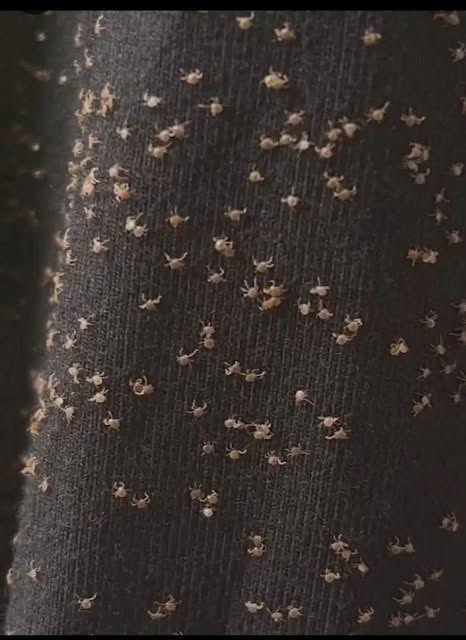
Naturally, I turned to the internet.
I compared what I found with photos of seeds, insects, plant debris, and anything else that commonly ends up stuck to clothing after spending time outdoors.
A few possibilities looked close.
None seemed exact.
For a brief moment, I even wondered whether they might be some kind of insect or egg cluster. The thought was enough to make me uncomfortable, although there was no real evidence to support it.
Still, uncertainty has a way of making ordinary things seem much stranger than they are.
As I continued removing them, I noticed an interesting detail: nearly all of them were concentrated on one side of my leg.
That suggested I hadn’t picked them up randomly.
I’d likely brushed against something specific.
Suddenly, a memory surfaced.
Near the end of my walk, there was a narrow section of trail where vegetation had grown close to the path. I remembered stepping slightly aside to avoid part of it.
That was probably where it happened.
To confirm my suspicion, I checked my shoes.
Sure enough, I found more of the same objects caught in the laces and along the seams.
Mystery partially solved.
Whatever these things were, they had definitely come from outside.
Later, I showed a few samples to someone more familiar with plants and outdoor environments.
Their response came almost instantly.
“Those are probably burrs or seed pods.”
Everything suddenly made sense.
Many plants have evolved remarkable ways of spreading their seeds. Rather than relying only on wind or water, some species produce tiny hooks, barbs, or bristles specifically designed to cling to fur, feathers, and clothing.
The most surprising part wasn’t what they were—it was realizing that I had unknowingly become part of the plant’s travel plan.
The real surprise wasn’t that the seeds attached themselves—it was why they were designed to do it in the first place.